










The Science of Oral Nicotine Addiction: How Dependence Forms
Oral nicotine addiction science explains how nicotine binds to acetylcholine receptors in the brain, triggering dopamine release and creating a reinforcement loop that drives physical dependence. Unlike smoking, oral products deliver nicotine more slowly but sustain blood-plasma levels longer, which can make the habit harder to break than it looks. Genetic variants in the CHRNA5-A3-B4 gene cluster, combined with behavioral conditioning, determine how quickly dependence forms and how severe withdrawal becomes.

The Oral Nicotine Addiction Science: How Dependence Forms in the Brain
Nicotine hijacks the brain's reward circuit by binding to specific receptors and flooding it with dopamine, a process that begins within minutes of your first pouch.
How Nicotine's Effects on Dopamine and Neural Pathways Create Physical Dependence
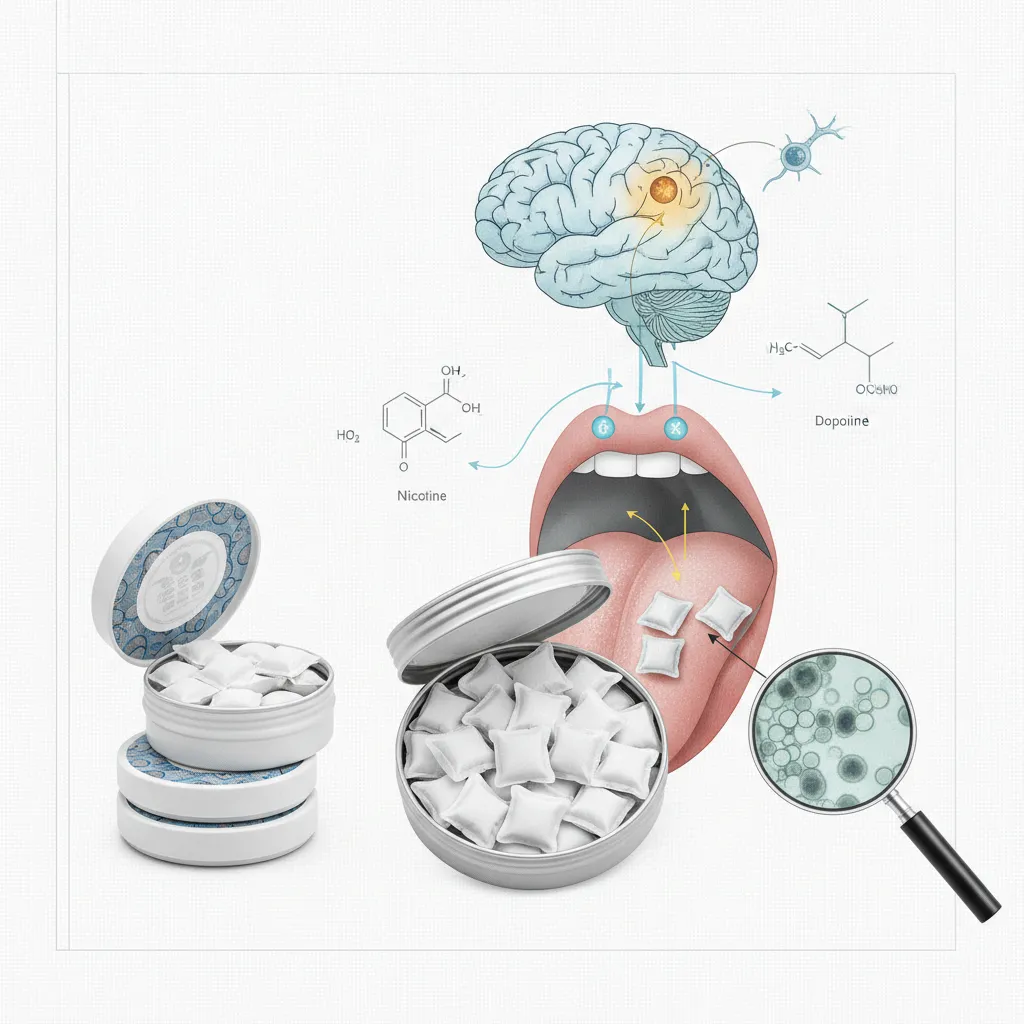
When nicotine enters the bloodstream through the oral mucosa, it binds to nicotinic acetylcholine receptors (nAChRs), specifically the α4β2 subtype, in the ventral tegmental area of the brain [1]. That binding triggers a surge of dopamine into the nucleus accumbens, the brain's core reward circuit, reinforcing the behavior immediately.
According to research published in PMC on nicotine addiction, the neurobiological mechanisms underlying nicotine dependence are among the most well-characterized of any addictive substance, involving multiple neurotransmitter systems beyond dopamine alone.
Via inhalation, nicotine reaches the brain in 10–20 seconds. Via oral mucosa absorption, the transit takes 3–5 minutes [2]. The slower onset doesn't prevent dependence, it just changes the shape of the reward signal, producing a steadier dopamine curve rather than a sharp spike.
Repeated exposure drives receptor upregulation: the brain grows additional α4β2 receptors to compensate for constant stimulation [1]. This is the direct mechanism behind tolerance. More receptors means the same dose produces less effect, so you reach for another pouch sooner. The oral nicotine addiction science here is straightforward, the brain is adapting, and that adaptation is working against you.
"Nicotine is one of the most addictive substances known, and the route of administration shapes the addiction profile but does not diminish its severity." — Dr. Neal Benowitz, Professor of Medicine, University of California San Francisco
What Role Withdrawal Symptoms Play in Maintaining the Addiction Cycle
Addiction doesn't run on pleasure alone. Researchers describe three phases: binge/intoxication (the reward hit), withdrawal/negative affect (the discomfort when nicotine drops), and preoccupation/anticipation (the craving that drives the next dose) [1]. All three are active in regular oral nicotine users.
Withdrawal symptoms typically include the following:
- Irritability and mood disturbances
- Difficulty concentrating or cognitive fog
- Increased appetite and weight gain
- Restlessness and anxiety
- Strong cravings for nicotine
- Sleep disturbances
These symptoms emerge within 2–4 hours of the last dose and peak between 24 and 72 hours [1]. That window is short enough that most users never reach it before they've already opened a new can. The craving cycle sustains itself not because the reward is so strong, but because the discomfort of abstinence arrives so fast.
Oral Nicotine Products vs. Smoking: Addiction Potential and Bioavailability Compared
Cigarettes absorb faster and hit harder than any oral nicotine product, but high-strength pouches held for 30–60 minutes can match cigarette plasma levels.
Absorption Rates and Bioavailability Differences Between Pouches, Lozenges, Gum, and Cigarettes
A cigarette delivers nicotine to arterial blood within 10–20 seconds [1], producing a sharp dopamine spike that no oral product can replicate in speed. That rapid onset is precisely what makes smoking so reinforcing, the brain learns to associate the act with an almost immediate reward.
Oral products absorb through the buccal mucosa at a slower rate, but they sustain plasma nicotine levels for longer. Nicotine gum delivers roughly 50–70% of its labeled dose [2]; lozenges reach closer to 60–80% [2]. Modern high-strength pouches, 8 mg to 12 mg formats held for a full 30–60 minutes, can approach plasma curves that rival a cigarette over that window.
The oral environment's pH is a key variable in oral nicotine addiction science. When mouth pH rises above 7, a higher proportion of nicotine exists in its un-ionized form, which crosses the buccal mucosa significantly faster [1]. Several pouch manufacturers use buffering agents, typically sodium carbonate or bicarbonate, to push pH into that alkaline range and accelerate uptake.
"The bioavailability of nicotine from oral products is highly dependent on formulation factors including pH, and users are often unaware of how dramatically these variables affect their actual nicotine exposure." — Dr. Jack Henningfield, Adjunct Professor of Behavioral Biology, Johns Hopkins University School of Medicine
Why Some Oral Nicotine Products Create Stronger Addiction Potential Than Others
Addiction potential is not automatically lower because there's no smoke. A 6 mg or higher pouch used for extended holds, with alkaline buffering, can produce nicotine plasma curves that exceed a single cigarette, the delivery is slower, but the total dose absorbed is comparable or greater.
This matters for anyone comparing pouches to vaping or trying to understand what nicotine pouches actually are before switching. The strength on the label doesn't tell the full story, hold time, pH buffering, and pouch format all shape how much nicotine reaches your bloodstream. Outdare's Clean Nicotine pouches are available in 6 mg, 12 mg, and 15 mg precisely because users transitioning off cigarettes or high-strength competitors need a starting point that matches their current intake before they can meaningfully step down.
Brain Mechanisms and Genetic Factors That Increase Nicotine Addiction Vulnerability
Genetic variants and baseline brain chemistry differences explain why some people become dependent on oral nicotine after days, while others take months or never do.
Which Genetic Variations Increase Susceptibility to Nicotine Dependence
The most replicated finding in oral nicotine addiction science is the CHRNA5-A3-B4 gene cluster on chromosome 15 [1]. The rs16969968 variant within CHRNA5 raises dependence risk by approximately 30% and appears in roughly 35% of people of European ancestry, meaning more than one in three pouch users carries a biological headstart toward addiction.
The CYP2A6 enzyme controls how fast your liver clears nicotine from the bloodstream. Slow-metabolizer variants keep plasma nicotine elevated longer after each dose [1]. That sounds like protection, but it isn't, fewer daily uses paired with sustained nicotine exposure per session can deepen physical dependence even when total daily intake looks modest.
How Individual Differences in Brain Chemistry Affect Addiction Vulnerability
People with the DRD2 Taq1A polymorphism have naturally lower baseline dopamine tone [1]. Nicotine's dopamine spike hits them harder by contrast, making the reward signal disproportionately strong, and the absence of nicotine disproportionately uncomfortable.
Prefrontal cortex development adds another layer of risk. The PFC, the brain's impulse-control center, isn't fully mature until the mid-twenties [1]. Adolescents and young adults who start using oral nicotine pouches before that window closes form dependence significantly faster than older users, which matters given how rapidly pouch use is spreading among under-25s across Europe.
These neurological vulnerabilities don't disappear once dependence forms, they shape how hard breaking the habit becomes. If you're already experiencing the cognitive side of this, the brain fog from nicotine article covers what's happening to your focus and how to address it.
Psychological and Behavioral Addiction: How Oral Nicotine Use Differs from Smoking and Vaping
Oral nicotine creates its own behavioral anchors, conditioned routines tied to specific contexts, that are just as entrenched as the hand-to-mouth ritual of smoking.
Unique Behavioral Patterns and Triggers Associated with Oral Nicotine Use
Pouches lack the visual smoke cue and the physical act of raising a cigarette or vape to your lips. But the brain doesn't need those cues to build a dependency loop. Placing a pouch before a meeting, during a commute, or after a meal becomes a conditioned stimulus, the context itself triggers craving, independent of nicotine's chemical pull.
The discreet, socially invisible nature of oral nicotine makes this worse. You can dose in an office, on a flight, or at the gym, environments where smoking is impossible. That constant accessibility increases daily use frequency and deepens behavioral entrenchment faster than smoking typically allows.
Common behavioral triggers identified in oral nicotine users include:
- Work stress and high-pressure meetings
- Post-meal routines
- Commuting or long drives
- Social settings where others are using nicotine
- Morning wake-up rituals
- Periods of boredom or low stimulation
Cue-reactivity research confirms that oral nicotine users develop strong context-specific cravings, work stress, post-meal, social settings, that persist well after physical withdrawal resolves [2]. This is the core problem that oral nicotine addiction science keeps surfacing: tapering the nicotine dose alone often fails because the behavioral layer remains fully intact. It's why approaches like Outdare's 4-week reduction method address the ritual and sensory components first, using sensorially identical Energy and CBD pouches to keep the habit loop satisfied while the chemical dose drops. You can read more about tobacco-free alternatives that work with this behavioral model, or explore relapse prevention techniques that actually work for managing context-specific triggers.
How Dual-Use Patterns Affect Overall Addiction Severity
A significant share of pouch users don't replace smoking or vaping, they stack on top of it. Survey data shows 30–40% of oral nicotine users also smoke or vape concurrently, a pattern called dual use. Dual use is associated with higher total nicotine intake and greater dependence severity than single-product use alone.
The behavioral explanation is straightforward: pouches fill the gaps where smoking isn't socially or legally possible, while cigarettes or vapes remain the default in permissive settings. The result is near-continuous nicotine exposure across the day, and a behavioral repertoire tied to two distinct rituals instead of one, making cessation harder on both fronts.
Clinical Guidelines and Evidence-Based Treatments for Oral Nicotine Addiction
Current clinical guidance recommends combination NRT, varenicline, and CBT as the three pillars of effective oral nicotine dependence treatment.
What 2023–2024 Regulatory and Clinical Guidelines Recommend for Oral Nicotine Addiction
The 2023 US Public Health Service Clinical Practice Guideline update explicitly includes oral nicotine users, not just smokers, in its first-line treatment recommendations for the first time. It endorses combination NRT (a nicotine patch paired with a short-acting form) as the preferred starting point for this population.
The 2024 European Respiratory Society and European Society of Cardiology (ERS/ESC) joint guidance goes further. It names varenicline (sold as Champix in Europe, Chantix in the US) as the most effective single pharmacotherapy for nicotine dependence, with quit rates 2–3× higher than placebo, and explicitly extends that endorsement to oral tobacco and nicotine pouch dependence.
Harm-reduction tapering is also clinically supported as a bridge strategy for users unwilling to attempt abrupt cessation. Stepping down nicotine strength, for example, from 8 mg to 4 mg to 2 mg pouches, over an 8–12 week period reduces withdrawal severity while maintaining the oral ritual, making full cessation more achievable.
"Behavioral support combined with pharmacotherapy consistently outperforms either approach alone, and this principle applies equally to oral nicotine dependence as it does to cigarette smoking." — Dr. Caryn Lerman, Director, USC Norris Comprehensive Cancer Center
Which Evidence-Based Treatments Are Most Effective for Oral Nicotine Dependence
What the oral nicotine addiction science consistently shows is that pharmacotherapy alone is not enough. Cognitive Behavioral Therapy (CBT) targeting cue-reactivity and behavioral triggers improves abstinence rates by 40–60% at 6 months when combined with medication, a meaningful gap that reflects just how strongly conditioned the oral habit becomes.
CBT is non-optional for oral nicotine users precisely because the ritual component, the placement, the burn, the sensory loop, is so deeply encoded. Addressing only the chemical dependency while ignoring the behavioral triggers leaves the majority of the addiction intact. Outdare's 4-week reduction method is built on exactly this principle: its three sensorially identical pouches (Nicotine, Energy, and CBD) preserve the physical ritual while progressively reducing chemical exposure, which maps directly onto what behavioral science recommends.
If you're ready to act on these treatment frameworks, Nicotine-Free Pouches: Complete Guide to Zero-Nicotine covers the practical next step in detail.
Frequently Asked Questions
Is oral nicotine addiction as serious as cigarette addiction?
Oral nicotine addiction drives the same dopaminergic dependency as cigarette smoking, the delivery method differs, but the neurochemical outcome does not. Nicotine from pouches or gum reaches the brain via the bloodstream and binds to the same α4β2 nicotinic acetylcholine receptors that cigarette nicotine targets [1]. The key difference is the absence of combustion toxins, which reduces cancer and cardiovascular risk, but the dependency itself is equally real. Users who switch from cigarettes to high-strength pouches often report withdrawal symptoms of comparable intensity when they attempt to stop.
How long does it take to become physically dependent on nicotine pouches?
Physical dependence can develop within a few weeks of daily nicotine pouch use, sometimes faster in people with a genetic predisposition to addiction [1]. Nicotine tolerance, needing more product to achieve the same effect, typically appears within days of consistent use. Once the brain recalibrates its baseline dopamine activity around regular nicotine input, skipping a dose triggers measurable withdrawal: irritability, difficulty concentrating, and strong cravings. Daily use is the primary accelerant.
Can you use nicotine gum or lozenges to treat a nicotine pouch addiction?
Nicotine gum and lozenges can reduce withdrawal severity, but they don't address the oral ritual that drives a large share of pouch dependency. Standard NRT products replace the chemical component of addiction while ignoring the sensory habit loop, the gum burn, the pillow sensation, the act of placing something under the lip. That gap is exactly why many pouch users relapse after NRT: the ritual remains unsatisfied. A substitution system that replicates the full sensory experience alongside chemical reduction tends to be more effective for this specific habit pattern.
What are the first signs that oral nicotine use has crossed into addiction?
The clearest early signs are reaching for a pouch automatically, without consciously deciding to, and feeling irritable or unable to concentrate when one isn't available. Other indicators include escalating to a higher strength to get the same effect, using pouches in situations where you previously wouldn't (first thing in the morning, during the night), and failed attempts to cut back despite intending to. If the pouch no longer feels like a choice, dependency has already set in.
Does oral nicotine addiction respond differently to treatment than smoking addiction?
Oral nicotine addiction shares the same core neurochemical mechanisms as smoking addiction, but the behavioral component differs significantly. Because oral nicotine can be used discreetly in almost any setting, users often develop a broader and more deeply embedded set of situational triggers than smokers do. This means behavioral therapies targeting cue-reactivity are especially important for oral nicotine users. Pharmacological treatments such as varenicline and combination NRT remain effective, but must be paired with strategies that address the unique ritual and contextual triggers of oral use.
Conclusion
Oral nicotine addiction is driven by three interlocking forces: the neurochemical pull of dopamine and receptor upregulation, the sensory habit loop baked into the pouch ritual, and the genetic factors that determine how fast dependency takes hold [1]. Addressing only one of these, as most NRT products do, leaves the other two intact and sets up relapse.
The most practical takeaway from the science is that the ritual accounts for roughly 60% of what keeps you hooked. Replacing nicotine pouches with a sensorially identical alternative, same burn, same mouthfeel, same mint, lets your brain stay in the habit while the chemical load drops. That's the logic behind Outdare's 4-week reduction method.
If you're ready to test that approach, start with Outdare's Discovery Pack: one order gives you all three pouch variants so you can run the substitution protocol from day one without committing to a full supply.
Sources & References
Recommended Articles
Explore more from our content library: